
By Ace Icing — Special Report for Sources Media News
Investigative Series: From Cotton Country to Sanctions
2025
From Cotton to Fuel: Sakunda’s Strategic Pivot
By 2008, Zimbabwe was in the throes of an economic crisis. Hyperinflation had rendered local currency nearly worthless, fuel shortages were chronic, and the black market for U.S. dollars dominated commerce. In this context, Kudakwashe Tagwirei’s Sakunda Holdings transitioned decisively from trading commodities to importing fuel — a move that would redefine both the company and the country’s energy landscape.
The timing was fortuitous. Fuel imports were tightly regulated by the state, and access to scarce U.S. dollars required both political connections and financial sophistication. Sakunda leveraged its early relationships with the Ministry of Energy and the Reserve Bank of Zimbabwe to secure dollar allocations, allowing the company to import petrol and diesel at volumes unattainable by competitors (NewsDay, 2018).
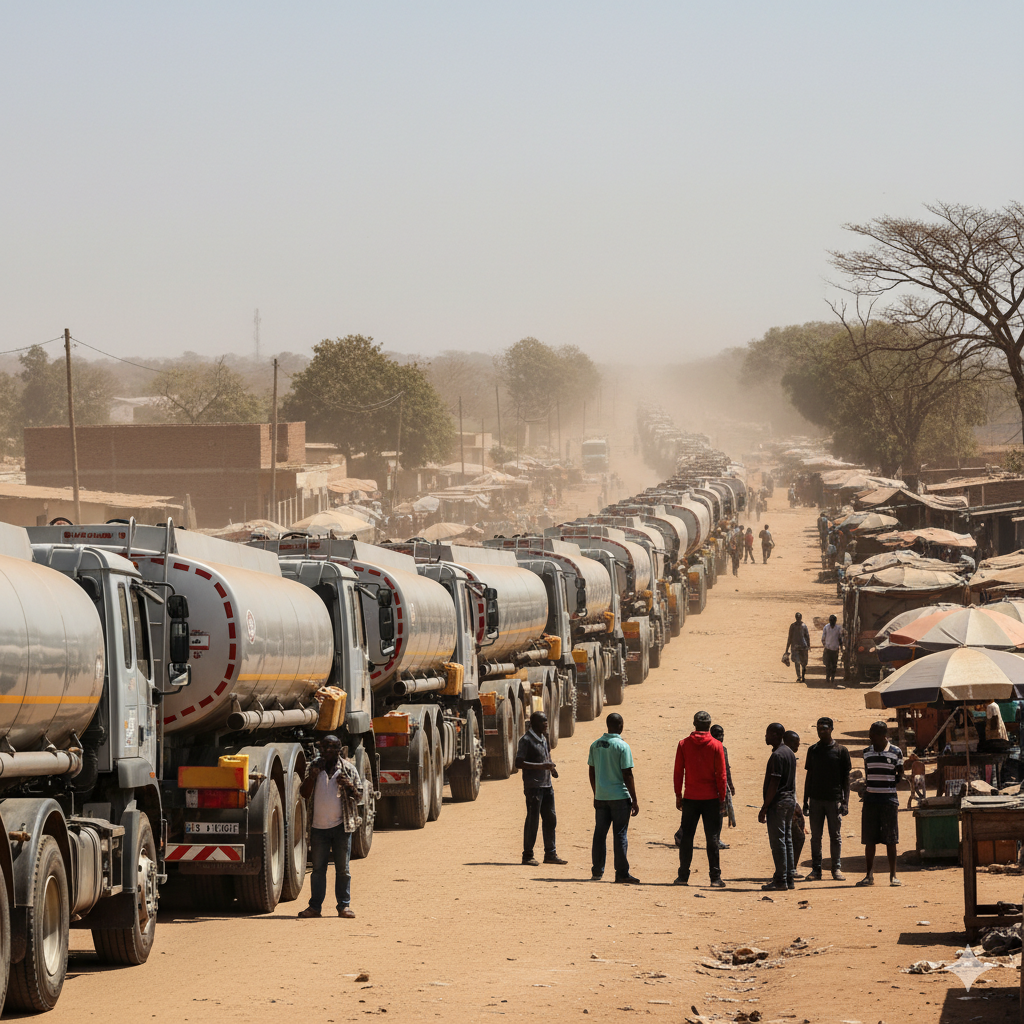
“A line of fuel tankers stretches into the distance on a dry, unpaved road in Africa, underscoring the wait for supply. Source: Sources Media .”
The scale of this operation drew scrutiny. Government audits later revealed that Sakunda and affiliated companies controlled approximately 70% of Zimbabwe’s fuel imports by 2014 (NewsDay, 2024). Analysts described the arrangement as a “quasi-monopoly” made possible by preferential currency allocation and close ties to the political elite.
Command Agriculture: A Billion-Dollar Opportunity
In 2016, the Zimbabwean government launched the Command Agriculture program, an ambitious effort to reverse the country’s declining agricultural output. The program involved supplying farmers with inputs — seed, fertilizer, and machinery — financed through state-backed loans or treasury bills. Sakunda became one of the principal contractors, providing bulk inputs, logistics, and fuel for mechanized farming operations (ZimLive, 2019).
Investigations by Parliament and independent media revealed that Tagwirei’s companies received large amounts of treasury bills, which were converted into U.S. dollars and used to finance further business expansion. A former government official described the process:
“It was clear from the beginning that certain contractors had both the connections and the currency to make the program function — or appear to function — more efficiently than others” (OCCRP, 2021).
The scale was unprecedented. According to parliamentary reports, Sakunda received contracts worth billions of dollars, making it one of the largest recipients of government-backed funding for agriculture. Critics argue that the program, intended to boost food security, instead became a mechanism for wealth accumulation among politically connected businessmen.
Diversification into Mining, Infrastructure, and Agriculture
Beyond fuel and agriculture, Tagwirei systematically diversified his portfolio.
- Landela Mining: Established around 2018, focusing on coal mining contracts with state utilities (Chronicle, 2021).
- Sotic International: Infrastructure firm securing road, energy, and urban development contracts (The Herald, 2023).
- Fossil Agro: Agricultural operations, including mechanized commercial farms linked to Command Agriculture.
The strategic logic was clear: a vertically integrated conglomerate capable of controlling production, transport, and supply of essential commodities. In each sector, access to government contracts and state-backed currency allowed rapid scaling, leaving competitors with fewer resources struggling to maintain market share.
Currency, Procurement, and the Machinery of Advantage
The story of Tagwirei’s empire cannot be told without understanding Zimbabwe’s foreign-currency environment. In a country where U.S. dollars were scarce and the black-market rate diverged sharply from the official rate, control over dollar allocations meant power. Sakunda, by virtue of state connections, consistently received preferential allocations, enabling fuel imports and agricultural input procurement that ordinary businesses could not achieve (OCCRP, 2021).
Government audits later revealed the mechanics: treasury bills issued to Sakunda were often used to purchase foreign currency directly, which was then applied to contracts across multiple sectors. Observers argued that this system both entrenched inequality and incentivized political loyalty over efficiency or innovation (World Bank, 2021).
Key Milestones: 2006–2016
| Year | Event |
|---|---|
| 2006 | Sakunda begins structured fuel imports under state license |
| 2008 | Secures major allocations amid hyperinflation |
| 2012 | Forms trading partnerships with international commodity firms |
| 2015 | Sotic International incorporated for infrastructure contracts |
| 2016 | Becomes primary contractor for Command Agriculture program |
“Tagwirei’s expansion from fuel to a multi-sector conglomerate during a decade of economic instability.”
The Political Logic of Expansion
Tagwirei’s ability to secure multi-billion-dollar contracts was closely linked to his political proximity. Multiple sources confirm that he maintained active communication with senior figures in the Ministry of Agriculture and the Ministry of Energy, as well as President Emmerson Mnangagwa (home.treasury.gov, 2020). Such relationships allowed not only contract awards but also favorable terms of payment, currency access, and priority in allocation of critical inputs.
Economists and governance specialists describe this pattern as “state capture in practice”: an arrangement in which private interests leverage political influence to gain disproportionate economic advantage, often at the expense of transparency and broader social benefit (Sentry, 2021).
Comparative Insights: Africa’s Politically Connected Tycoons
Tagwirei’s trajectory resembles other African figures whose empires are entwined with the state. Dan Gertler in the DRC capitalized on mining concessions and government ties to control strategic natural resources. Isabel dos Santos leveraged Angolan oil revenues and state contracts to accumulate vast holdings in banking, telecommunications, and energy.
Such cases illustrate a common pattern: in environments where formal market mechanisms are weak, access to political power can substitute for competitive advantage, creating concentrated wealth and oligopolistic control (Reuters, 2020).
Consequences for Zimbabwe’s Economy
While the expansion created jobs and ostensibly bolstered food and energy supply, the concentration of economic power raised systemic risks. Critics argue that the preferential allocation of dollars and contracts contributed to distortions in the market, limiting competition and inflating prices (NewsDay, 2024).
Moreover, by tying business success to political proximity, the system fostered incentives for loyalty over efficiency, potentially slowing broader economic reform. Tagwirei’s rise thus exemplifies how state-connected entrepreneurship can simultaneously drive growth and entrench inequities.
The Architecture of a Conglomerate
By 2016, Sakunda Holdings had become the central node in a sprawling network of businesses. Through diversified subsidiaries — energy, mining, agriculture, infrastructure, and automotive — Tagwirei achieved both vertical and horizontal integration, reducing exposure to sectoral shocks and creating a business ecosystem tightly aligned with state priorities.
Financial analysts note that the architecture of this empire allowed rapid reinvestment of profits into strategic areas, often using government-backed instruments. In essence, the conglomerate was a hybrid of private entrepreneurship and state-facilitated accumulation, designed to exploit Zimbabwe’s particular mix of market volatility and political patronage.
Conclusion
The decade between 2006 and 2016 solidified Tagwirei’s position as one of Zimbabwe’s most powerful businessmen. His strategy — leveraging scarce currency, cultivating state ties, and expanding across multiple sectors — provides a blueprint for understanding the emergence of politically connected conglomerates in fragile economies.
In Part 3 of this series, we will examine the networks of influence and state capture that enabled this consolidation of power, mapping the political and financial relationships that made Tagwirei’s empire not just profitable but resilient amid scrutiny and, eventually, international sanctions.
Part Two of our Investigative Series.
We are committed to exposing the forgotten history and concealed facts necessary for a truly informed public. The full narrative of Zimbabwe cannot be corrected in a single effort; however, with the support of our dedicated writers and funders, we will systematically challenge and rewrite the selective record, one investigation at a time.