
By Ace Icing — Special Report for Sources Media News
Investigative Series: From Cotton Country to Sanctions
2025
The Architecture of Influence
By the mid-2010s, Kudakwashe Tagwirei had transformed from a regional trader into a central figure in Zimbabwe’s economic and political ecosystem. His ascent was not merely a matter of business acumen; it was equally a story of cultivated political capital, strategic alliances, and access to state levers of power.
Investigative reports suggest that Tagwirei’s influence extended across multiple government ministries, state-owned enterprises, and even the office of the president (OCCRP, 2021). Analysts describe him as emblematic of a new elite in Zimbabwe: wealthy, politically connected, and able to operate with minimal regulatory constraint.

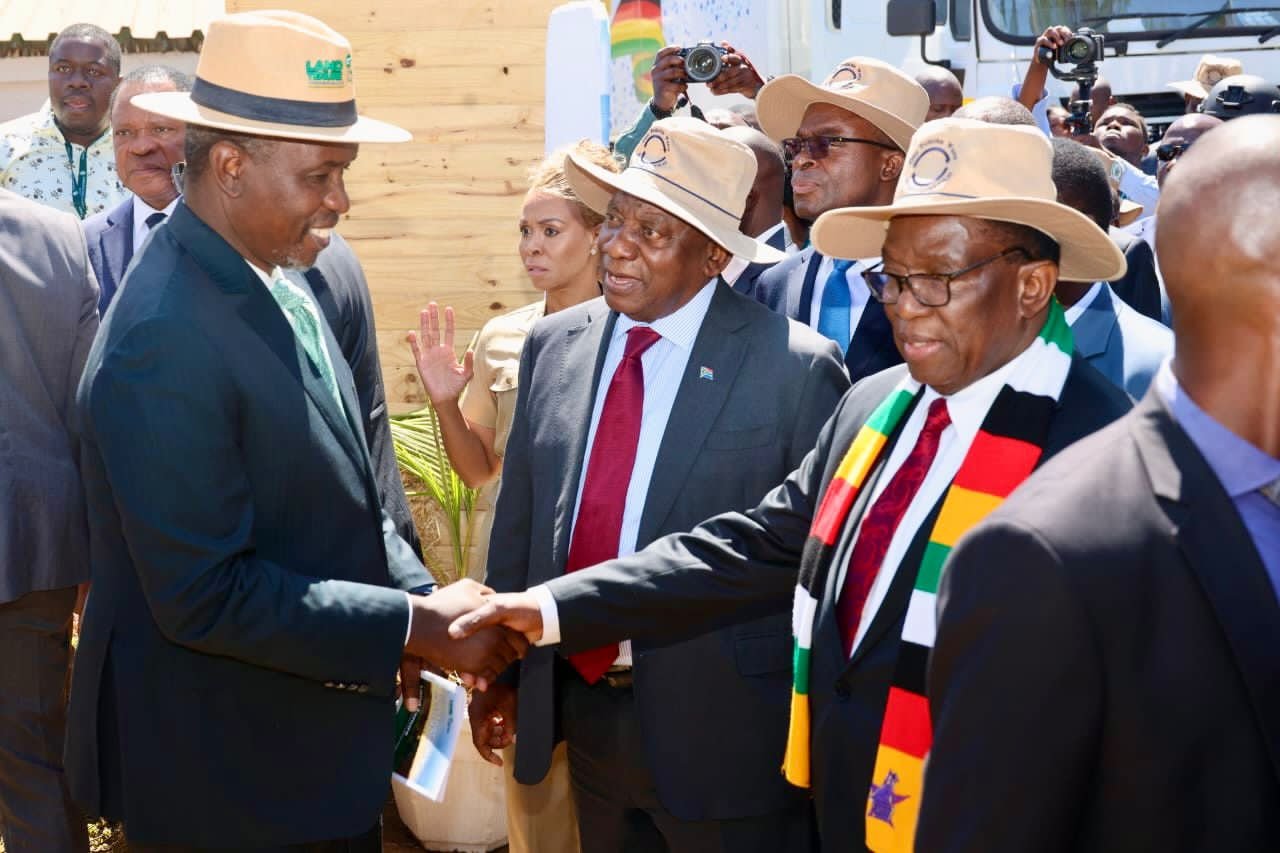
“Tagwirei in Harare, with South Africa President Cyril Ramaphosa and Zimbabwean President Emmerson Mnangagwa. Photo: Ministry of Information.”
ZANU-PF and Political Patronage
From early in his career, Tagwirei demonstrated strategic engagement with Zimbabwe’s ruling party, ZANU-PF. According to campaign finance records and media reports, he became a significant donor to party initiatives, facilitating relationships with senior party officials (BBC News, 2021). These financial contributions were not purely philanthropic; they established him as a trusted partner in projects of national significance, including energy distribution, agricultural mechanization, and infrastructure development.
Political patronage provided access to regulatory approvals, foreign-currency allocations, and lucrative government contracts, creating a reinforcing cycle of wealth and influence. Economists describe this as a “mutually reinforcing oligarchic ecosystem,” where political loyalty and financial power are interdependent (World Bank, 2021).
Ministries and State Enterprises: Strategic Leverage
Ministry of Energy: Tagwirei’s early control of fuel imports gave him an unusual level of influence in Zimbabwe’s energy sector. Access to import licenses and preferential allocation of foreign currency allowed Sakunda Holdings to dominate the market, creating dependence for both government operations and private consumers (NewsDay, 2024).
Ministry of Agriculture: Through the Command Agriculture program, Tagwirei became the principal contractor supplying inputs and machinery, effectively shaping national agricultural output. Parliamentary reports indicate that his companies were awarded contracts worth billions, raising questions about transparency and competitive fairness (Parliament of Zimbabwe, 2022).
Reserve Bank of Zimbabwe (RBZ): Control over foreign-currency allocations amplified his leverage across sectors. By obtaining preferential rates and timely access to scarce U.S. dollars, Tagwirei could fund operations that competitors could not match (OCCRP, 2021).
Key Political Connections: 2010–2020
| Connection | Nature | Evidence |
|---|---|---|
| ZANU-PF | Financial donor, strategic ally | Campaign finance reports, BBC News (2021) |
| Ministry of Agriculture | Command Agriculture contracts | Parliamentary Portfolio Committee on Agriculture (2022) |
| Ministry of Energy | Fuel import licenses | NewsDay audit (2024) |
| Reserve Bank of Zimbabwe | Foreign currency allocations | RBZ statements (2020–2023) |
| President Mnangagwa | Close business associate | Media reports, sanctions documentation (US, UK, EU) |
“Tagwirei’s connections to Zimbabwe’s political and bureaucratic elite underpin his empire-building strategy.”
Networks of Influence: Beyond Zimbabwe
Tagwirei’s model reflects patterns seen across Africa, where political connections substitute for market competition. Dan Gertler in the DRC leveraged political access to secure lucrative mining deals. Isabel dos Santos in Angola used her family ties to dominate sectors from banking to energy (Reuters, 2020).
In each case, political proximity functioned as a currency, allowing select business figures to access scarce resources, evade regulatory scrutiny, and consolidate power in strategic sectors.
State Capture and Economic Implications
Economists describe Tagwirei’s rise as a form of state capture: private interests co-opting public institutions to secure disproportionate economic advantage. The impact is profound: while large contracts and investments generate employment and activity, they distort markets, concentrate wealth, and reduce transparency (Sentry, 2021).
By integrating business operations with state mechanisms — from currency allocation to tender awards — Tagwirei created a self-reinforcing ecosystem where political loyalty and business success were inseparable. Critics argue this model undermines institutional capacity and perpetuates systemic inequality.
The Role of International Observation
International watchdogs have chronicled Tagwirei’s network of influence. The US Treasury, UK Treasury, European Union, and Canada imposed sanctions citing corruption, state capture, and human rights concerns (US Treasury, 2020; UK Treasury, 2021; EU Council, 2023; Global Affairs Canada, 2024).
Sanctions documents highlight his ties to ministries, party structures, and state financial instruments. They also underscore the international perception that elite networks like Tagwirei’s can pose systemic risks to governance, transparency, and economic stability.
Comparative Perspectives on Patronage Economies
Across Africa, politically connected tycoons operate in what scholars term patronage economies. These systems allocate resources and opportunities based on loyalty and access rather than market competition. In Zimbabwe, Tagwirei’s access to treasury bills, import licenses, and multi-billion-dollar contracts demonstrates how patronage networks facilitate both rapid accumulation of wealth and consolidation of political influence (World Bank, 2021).
Consequences for Governance and Society
The intertwining of business and state authority raises questions about institutional resilience. Parliamentary reports suggest that contracts were often awarded with minimal transparency, and independent oversight of expenditure was limited (Parliament of Zimbabwe, 2022).
For citizens, the consequences are mixed: on the one hand, infrastructure projects, fuel supply, and agricultural inputs were delivered. On the other, market distortions, inequality, and erosion of public trust were significant. Tagwirei’s network exemplifies how elite capture can simultaneously stimulate and distort economic activity.
Conclusion
Kudakwashe Tagwirei’s empire is as much political as it is commercial. His ascent illustrates the mechanics of elite networks in Zimbabwe: the alignment of financial resources with political access, the strategic use of state instruments, and the cultivation of loyalty across key institutions.
In the final part of this trilogy, Article 4 will examine how international sanctions targeted these networks, the strategies employed to circumvent restrictions, and the implications for Zimbabwe’s business and political landscape.
Part Three, watch out for part 4
We are committed to exposing the forgotten history and concealed facts necessary for a truly informed public. The full narrative of Zimbabwe cannot be corrected in a single effort; however, with the support of our dedicated writers and funders, we will systematically challenge and rewrite the selective record, one investigation at a time.